Product Knowledge
Cold Foil Routes: Flexo, Screen, Digital
Flexo, screen and digital cold foil compared by how the adhesive is placed and what each route does.
QUICK ANSWER
Flexo and screen share one mechanism: a UV adhesive is placed image-wise, the foil is nipped on, and the adhesive is cured while the foil is in place. Digital has two mechanisms of its own: toner-based, in which a toner image is bonded to the foil with heat and pressure; and adhesive-jet, whose base process pins and re-activates a polymer, presses the foil on, and cures the adhesive after the carrier is peeled. One adhesive-jet variant puts the adhesive on the foil. So the routes differ mainly in how the adhesive is placed, and substrate range, effect and run length all follow from that difference, while the machine configuration decides where the process sits in the line.
01 FOUR ADHESIVE-PLACEMENT MECHANISMS
On the flexo and screen routes the sequence is four steps: a UV-curable adhesive is applied image-wise; the foil is nipped onto the wet adhesive; the adhesive is cured with UV light while the foil is in place; the carrier is peeled and rewound. The metallic layer stays only where adhesive was printed, so transfer comes from the adhesive and the cure.
On those two routes the cure happens through the carrier, which is why a cold-foil carrier has to transmit UV and why lamp output, line speed and carrier have to match. That is the first thing to check when transfer is weak: the adhesive has not cured enough to hold. Neither digital mechanism works that way. Toner-based digital has no UV cure through the carrier and is UV-free, so a transfer fault sits in the toner image or in the separate transfer unit's heat, pressure and cooling zone. On the base adhesive-jet process the polymer is pinned, re-activated, pressed with the foil and finally cured after the peel, so a fault sits in the pinning, the re-activation or the final cure; in the foil-side variant it sits in the adhesive application or cure on the foil, and in the varnish variant in the varnish jetting or the bonding step.
Resolution follows the printed adhesive rather than a die, with the release layer as a secondary control on how cleanly the border tears. So the practical question is the same for all three routes - how precisely can the process place the adhesive, and how much can it lay down: flexo meters the adhesive with an anilox roller and carries the image on a plate or sleeve; screen forces a thick deposit through a stencil with a squeegee; digital writes the adhesive image with no plate or stencil.
02 WHAT "COLD" DOES AND DOES NOT MEAN
Cold means no heated die, not low temperature, and no die-temperature window. On the UV-adhesive routes the nip applies pressure and the cured adhesive bonds, which is why the recorded settings are curing power and running speed rather than degrees. Toner-based digital is the exception covered in section 05: it uses heat and pressure, but in a separate transfer unit rather than a shaped die.
The flatness of cold transfer is the real difference from hot stamping, and the usual version of this comparison is wrong. The documented distinction is not resolution: both routes are described as reaching high-gloss decoration, sharp-edged metallization and holographic effects, and cold transfer is documented for ultrafine detail. What hot stamping adds is haptic relief, because a heated die embosses the surface in the same step.
So the honest framing is relief, not quality. If the brief asks for a raised, tactile edge, cold transfer does not add hot-stamping-style die relief. If it asks for a flat metallic area or a fine line, flexo and digital are documented for it, while screen's documented strength is deposit thickness and we found no like-for-like resolution comparison for screen.
One more correction, because it causes specification errors. A cold-stamping film is often described as having no adhesive layer; that is too absolute. Cold-transfer films may carry a release layer, a protective lacquer, a primer or an adhesive layer, and one process supplier describes a cold film with a thermoplastic primer acting as an adhesion promoter. What is genuinely absent is the die-activated hot-melt function - the layer a hot die melts under pressure.
03 FLEXOGRAPHIC COLD FOIL
A flexographic unit applies the adhesive with a heavier anilox than for ink, with the image on a plate or sleeve. Published guidance is directional rather than numeric: different adhesive thicknesses suit different images, and broad areas need a lower line count. No anilox line count is published as a cold-foil specification by any source we could verify, so treat a number as job-specific and test it.
Documented applications are plastic self-adhesive labels, mainly polyethylene and polypropylene, plus paper labels, tube laminates and folding boxes. Shrink-sleeve work appears in a supplier announcement rather than technical literature; in-mold labels and general flexible packaging were not found.
The structural advantage is sequence. Cold transfer is a combination of printing and laminating, applied at the start of the run so the label can be overprinted in multiple colors afterwards. Because the foil goes down first, the effect can be overprinted in the same pass - a real design capability, documented on narrow- and mid-web label presses.
On substrate, our own application data records cold foil for PE, PP and PVC plus paper with no absorbent surface, in flexographic and letterpress UV-curing, small to medium areas, at 160 W/cm2 or more and 40 m/min, with transfer and slitting performance recorded. Two constraints apply: the 160 W/cm2 is a power floor, the 40 m/min is a recorded running speed and not a minimum. And the PVC entry is ours - third-party documentation lists PE, PP and PET but does not name PVC - so if PVC matters, ask for it rather than reading it off a generic list.
For economic context, one foil manufacturer publishes speeds of up to 120 m/min for narrow-web flexo cold transfer, alongside low upfront cost, no stamping dies and rapid changeovers, since only conventional plates are needed for the adhesive. A press builder's mechanical maximum for the same machine class is a different number and must not be read as a cold-foil speed.
04 SCREEN-PRINT COLD FOIL
Screen applies the adhesive through a stencil with a squeegee, so the deposit is thick, and deposit thickness is what the route is documented for. One cold-foil press builder states the process requires good brightness and a thick ink layer for local glazing, controlled with a heavy squeegee; a rotary-screen supplier states generally that thick layers in one pass enable effects flexo, offset, letterpress and gravure cannot produce. The cold-foil-specific point is the adhesive layer's thickness; the broader effects claim belongs to rotary screen in general.
Documented applications are mostly three-dimensional objects rather than flat print: glass, aluminum and plastic articles, bottles, jars and cups including conical shapes, tubes and sleeves. High-grade folding cartons are also documented, in the categories that carry heavy decorative finishing, and one in-line system can combine screen, flexo or digital printing in a single pass.
Keep those two worlds apart: bottles, jars and cups are not narrow-web label work, and a label printer should not conclude from a substrate list naming glass that the route drops into a label press. What transfers is the mechanism, not the machine.
We could not source two claims about this route, so we will not repeat them. The first is that screen cold foil is chosen for rough or textured board: we found no manufacturer or trade source stating it, and the foil maker we checked attributes structured-surface capability to hot stamping, not to screen cold foil. The second is that screen is coarser, slower or unsuitable for fine text: we found no like-for-like comparison, and the figures that circulate are sheets per hour on flatbed lines against meters per minute on web lines - different machines in different units.
05 DIGITAL COLD FOIL
Two mechanisms are in commercial use and behave differently enough to be specified separately.
Toner-based. A toner image becomes the adhesive: black toner or a dedicated transfer toner is printed where the metal should go, the foil is bonded to it with heat and pressure, and the carrier is removed before the color overprint. The heat and pressure come from a separate transfer unit with infrared heating, a silicone roller and a cooling zone - not from the digital press fuser - so a toner-based line is a print step plus a laminating step, and a fault can sit in either.
Adhesive-jet. The base process is a polymer jetted onto the sheet, pinned with UV, then re-activated with UV so it behaves as an adhesive; the foil is pressed on, the decorated layer peels from the liner, and a final UV cure follows. Two further variants exist: UV adhesive jetted onto the reverse of the foil and then transferred, or UV varnish jetted onto the substrate with metallized foil applied in line, bonding only where the varnish sits. The first inverts the arrangement - the adhesive is on the foil, not the sheet - which changes what you have to buy.
The tooling argument is real but narrower than usually stated. The foil-receiving image needs no plate, screen or die - hence tool-free - but it is not necessarily your CMYK artwork: it can be a separate toner layer or a jetted adhesive, and the underlying color print may still come off a press with plates. If a job is sold as plateless, ask which layers are plateless.
Two capabilities are documented for digital and distinguish it. Variable data: manufacturer material states each label can differ with variable elements and that variable printing can be combined with variable metallization - a manufacturer claim, not a tested result, but documented. Digital is the only documented route for varying the foil image itself from label to label. Uncoated stock: sheet-fed digital systems are documented running open-structure uncoated papers at full speed and foiling on uncoated paper and board, where the flexo guidance points to smooth coated papers and plastics for best results.
Documented applications include short-run labels, mock-ups, personalized print, security and brand-protection elements, high-end beauty and spirits packaging, secondary food packaging, shrink sleeves, special editions, book covers, stationery, certificates and cards, including one-off jobs.
Configuration is not standardized: in-line modules and stand-alone or near-line units are both commercial, and published sheet sizes, grammages and throughput figures belong to specific machines rather than the process, so take the specification of the machine you will run on. Foil supply is also system-specific - some machines use foils optimized for that machine, others accept market foils subject to a recommended-type list - so confirm compatibility with the machine supplier. One gap worth naming: no source we could verify states whether heavy ink coverage under the foil affects digital transfer, so if your artwork is dark under the metallic area, put it in the trial.
06 WHERE EACH ROUTE IS DOCUMENTED TO LEAD
Not a ranking: some capabilities overlap, and where they do the machine configuration decides.
Flexo is documented for same-pass integration: it applies the adhesive and lets you overprint the effect on a narrow- or mid-web label press without a second pass. Its documented applications include self-adhesive labels, paper labels, tube laminates and folding boxes.
Screen is documented for deposit thickness, and mainly for three-dimensional objects and heavy decorative cartons rather than flat label work.
Digital is documented for variable metallization and, on sheet-fed systems, for uncoated or open stock, and it removes tooling for the foil image - subject to the caveat above about which layers that covers.
Hot stamping is documented for relief - the boundary of the whole family.
The sheet-fed offset cold-foil route is a fourth case, covered separately on this site, because it is specified on different data: a different substrate set, a different speed, UV or non-UV curing, and recorded post-stamp printability. Mixing it into this comparison would blur all three.
07 WHAT THE GROWTH NUMBERS DO AND DO NOT SAY
This is where supplier copy overreaches, so here is what the numbers cover.
Digital print and finishing is where the published growth data sits, and none of it isolates cold foil: a manufacturer states digital embellishment continues to show strong growth, a trade report on a digital cold-foil development records demand growing fast in Asian markets, and the forecast for digital label printing is a 6.4% volume share in 2023 rising at a 12.3% compound annual rate to 2028.
Now the scope, because it matters: the first is about digital embellishment generally; the second reports demand around one digital cold-foil development; the third is about digital label printing as a whole. Using the 12.3% figure as a growth rate for digital cold foil would be a category error, and we are not going to do it.
At the other end, flexo represents 39.6% of world output of printed labels in 2023 and is described by the same source as the most popular narrow-web process - all label printing, not cold foil.
What is missing is the number everybody wants: no published source we could verify breaks cold foil down by printing method. So flexo being the volume cold-foil route, and digital catching up, are both plausible and both unsupported. What can be said is narrower: digital is the only route documented for variable metallization and, on sheet-fed systems, uncoated stock; flexo dominates label printing overall; screen is documented mainly for three-dimensional objects and high-grade cartons. No source ranks cold-foil routes by growth.
The demand side is better documented than the supply side. A 2019 member poll of label printers found 81% saying SKU proliferation was a factor affecting production, and industry forecast work describes run lengths shortening as brands diversify into more SKUs. That is a citable pressure and explains why a plateless route attracts interest - but it does not establish that cold-foil buyers are switching in any measurable quantity, and no source gives a break-even quantity between digital and conventional cold foil.
08 FIVE QUESTIONS, THEN A TRIAL
Each answer narrows the route.
The substrate, named precisely - coated art paper, white card, PE, PP, PET, PVC, an uncoated or open stock, a tube laminate, or a three-dimensional object. This decides more than anything else, because the routes do not share a substrate list and our own PVC entry is not on the third-party lists.
Whether the foil area is overprinted after transfer. If yes, sequence and line position matter, and the trial has to include the overprint.
The run length and how often the artwork changes. If the foil image itself must change from label to label within the run, only the digital route is documented for variable metallization; if it repeats, a plate or stencil change between runs is the conventional answer.
Whether the design needs relief. If it does, this is a hot-stamping job.
Whether the job is flat label work or a shaped object. Flat label work points to flexo or digital; flat high-grade cartons are also documented for screen; bottles and jars need a screen line built for objects.
Then trial it on your own stock at production speed, checking adhesion and, where the job is overprinted, the downstream overprint: cross-cut to ISO 2409 or tape to ASTM D3359 for whether the layer holds, ISO 1518-1 for scratch resistance, and ISO 2836 for printed areas where something is printed over the foil. These are industry methods for assessing a finished surface, not certificates.
Send the substrate, the run length, whether the foil area gets overprinted, whether the artwork changes within the run, and whether the design needs relief. Tell us also whether the job is flat label work or a shaped object. The first four narrow the route; the relief question decides whether cold foil is right at all, and the shape question decides whether you need an object line.
09 NEXT STEP
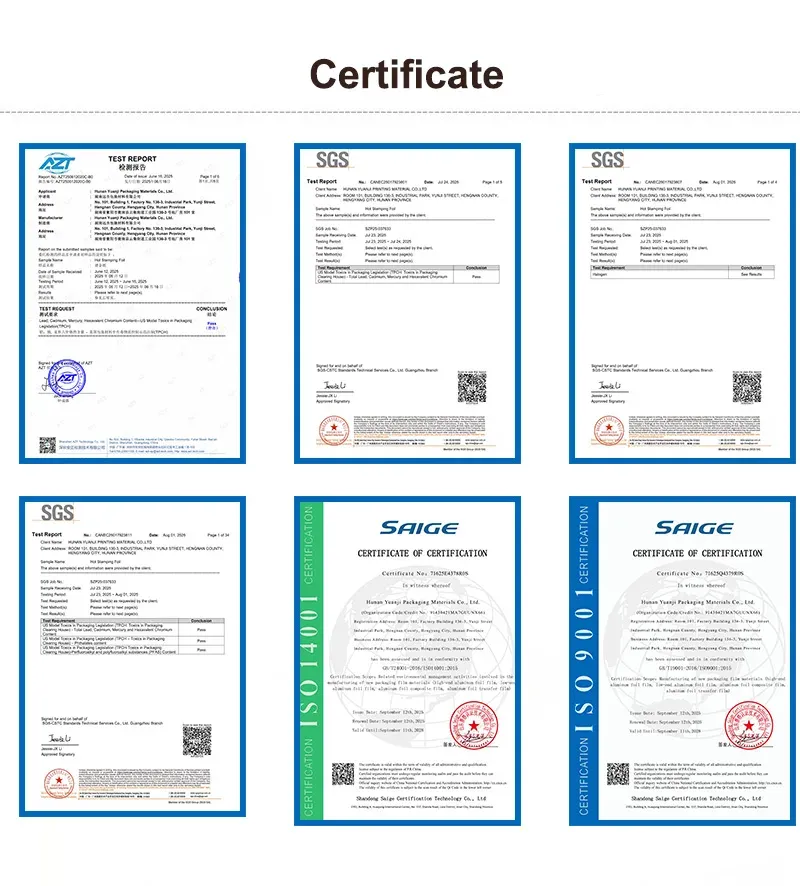
Tell us the route you can run - flexo, letterpress, screen, digital or sheet-fed offset - the substrate, the run length, and whether the foil is overprinted or carries variable data. For flexo, letterpress and sheet-fed offset we can match the job to our recorded cold-foil data. For screen we will tell you whether we have a qualified grade for your screen and cold-foil unit; for digital we will also check the machine supplier's foil-compatibility list. We will send a sample only where we have a qualified grade. Yuanji Foil is a hot stamping and cold stamping foil manufacturer in Hengyang, Hunan, producing standard, cold stamping, holographic, pigment, coffee-tone, low-halogen and transparent-dielectric foils, with ISO 9001 and ISO 14001 management-system certificates and import and export rights.