Product Knowledge
Cold Foil for Offset Printing: Process Guide
What cold foil needs from your offset press: adhesive, curing, substrate and a trial run.
QUICK ANSWER
Cold foil transfers through an adhesive applied on press rather than a heated die, so the recorded settings are curing power and speed, not degrees. On paper packaging - sheet-fed offset coated art paper and white card, UV-curing or non-UV - the data is 160 W/cm2 or more at 35 m/min. On PE, PP, PVC and non-absorbent paper in flexo or letterpress UV-curing, it is 160 W/cm2 or more at 40 m/min, for small to medium areas. Settle which route your press can run first, because the two are specified separately.
01 WHAT MAKES IT A DIFFERENT PROCESS
On a hot-stamping press a heated die presses foil onto the sheet and the adhesive in the foil does the work. In the cold-foil route the sequence is different: the adhesive is applied on press, the foil is nipped onto that adhesive, and the adhesive is then cured. Transfer comes from the adhesive and the curing step.
That single difference explains why the recorded settings look the way they do. Instead of a temperature window in degrees C, the data gives curing power as a power density in W/cm2, plus a running speed in m/min. If you are used to reading hot-stamping data, that is the first thing to reset in your head.
02 THE TWO RECORDED ROUTES
Our application data sets out two cold-foil routes, and they are specified separately - which matters, because a job that is easy on one is not automatically easy on the other.
Paper packaging route. Single-sheet offset coated art paper and white card - folding cartons, sleeves, cards and labels - UV-curing or non-UV cold-foil offset, 160 W/cm2 or more at 35 m/min. The recorded performance covers transfer, slitting and post-stamp printability, the last of which matters if the sheet is printed after foiling.
Plastics and non-absorbent paper route. PE, PP and PVC components, plus paper with no absorbency, in flexographic or letterpress UV-curing cold foil, 160 W/cm2 or more at 40 m/min, for small to medium areas. Recorded performance is transfer and slitting.
Four things differ between the routes: the process, the substrate, the recorded speed, and the area the data covers. Note the curing options too - the paper route records both UV and non-UV, the plastics route records UV-curing only. If a supplier quotes one figure and one speed for "cold foil" without asking which route you run, the answer is not specific enough to plan a packaging job on.
03 WHAT TO SETTLE BEFORE THE RUN
Four things, in this order. Which route - sheet-fed offset, or flexo/letterpress - because that decides the specified data set. Which substrate, named precisely: coated art paper, white card, PE, PP, PVC, or a non-absorbent paper. Whether the curing is UV or non-UV, since only the paper route records both. And what follows the foil: the paper route is the one whose data records post-stamp printing performance, so say so if the carton is printed after foiling.
Two more items belong on the same list. The artwork should be agreed against a stamped proof rather than a file, since the effect depends on how the adhesive is applied. And the adhesive is a consumable that has to suit the substrate and the curing route - it is usually not interchangeable between jobs.
If you are the packaging developer rather than the printer, these same four questions are what to put in the brief you send your converter: route, substrate, curing, and what follows the foil. It is a short list, and it prevents most of the back-and-forth on a new carton.
04 ENERGY IS A FLOOR; SPEED IS A RECORDED LIMIT
The recorded 160 W/cm2 is a power-density floor at the recorded speed. Read the "or more" as a floor: below it the adhesive may not cure enough for the foil to hold, and the defect usually shows up as poor anchorage rather than as a transfer fault - which is why a transfer-only check can miss it.
Speed works the other way. The 35 m/min and 40 m/min figures are recorded running speeds, not floors. Running the paper route faster than its recorded speed does not make the job cheaper; it usually moves the failure from the foil to the adhesive, which is harder to see before the sheet is finished.
So the two numbers have opposite meanings, and neither can be copied from one job to the next. The power you need depends on your lamp, your adhesive laydown and your substrate, and the only way to find your own setting is a short trial on your own stock at production speed.
05 HOW TO PROVE IT ON YOUR OWN STOCK
A static foil swatch or a single flat sample tells you almost nothing about a cold-foil carton, because the failures appear as a combination of holding and curing rather than as one obvious defect. Run a short strip on press at the recorded power and speed, then check three things.
Does it hold. Adhesion of the transferred layer is assessed with ISO 2409:2020 (cross-cut) or ASTM D3359-23 (tape test). If the foil lifts cleanly from the sheet the adhesive or the cure is short; if it tears, the transfer itself is suspect.
Does it survive handling. Scratch resistance is assessed with ISO 1518-1:2023. An area that marks easily under a fingernail is a warning sign - confirm it with that scratch test before packing and shipping.
Does anything applied later stay put. If the sheet is overprinted after foiling, the printed areas can be assessed with print-resistance methods such as ISO 2836:2021, which covers resistance of prints to a range of agents including solvents.
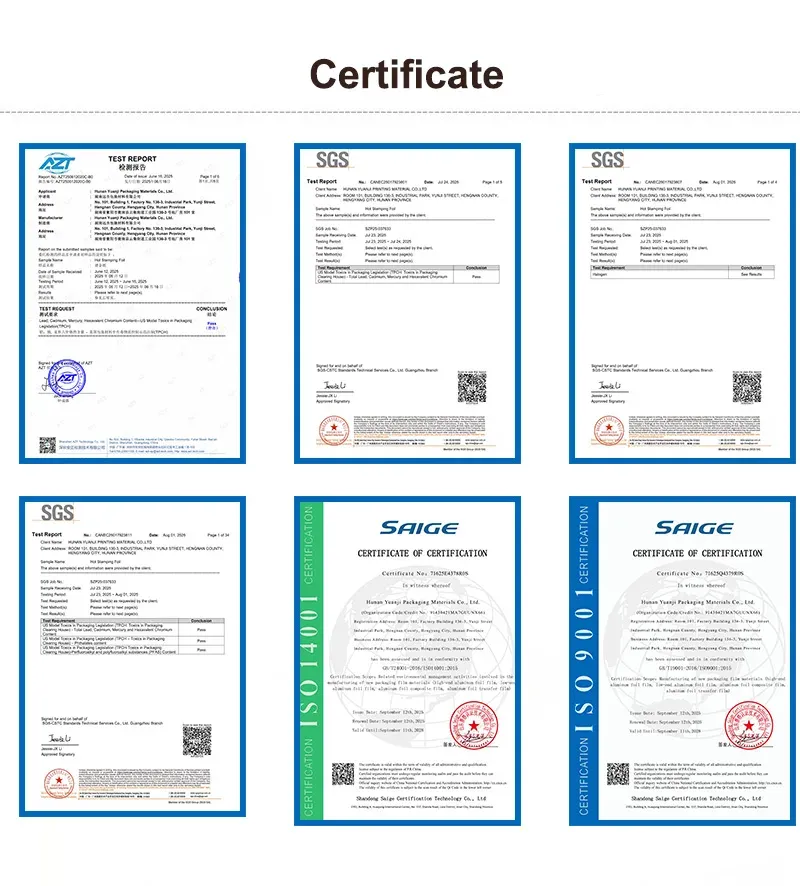
Then repeat the same checks on the first production delivery and compare with the trial record. These are industry methods for assessing a finished surface; none of them is a certificate.
06 WHEN COLD FOIL IS THE WRONG ANSWER
Cold foil is not a drop-in replacement for hot stamping. It needs an adhesive application step and a curing step, and the adhesive has to be matched to the substrate and the route. On a job where a hot grade already transfers cleanly inside its 90-120 C window, adding a second process can cost more than it returns.
The honest test is to cost both routes for the actual job - consumables, passes, curing and the reject rate you measured in the trial - rather than choosing on the strength of the effect alone.
07 NEXT STEP
Tell us your route - sheet-fed offset, flexo or letterpress - your substrate, whether you cure UV or non-UV, and what follows the foil. We will confirm which of our cold-stamping specifications covers it and send a sample for your own trial. Yuanji Foil is a hot stamping and cold stamping foil manufacturer in Hengyang, Hunan, producing standard, cold stamping, holographic, pigment and coffee-tone foils.