Product Knowledge
Genuine Leather, PU and PVC: Foil Behavior
PU, PVC and genuine leather share one grade window; the surface under the foil is what differs.
QUICK ANSWER
Our application data puts PU leather, PVC leather and genuine leather on one row, at one temperature - 90 to 120 C - with one grade. That is a starting point, not a claim that the three behave alike, and it has a practical consequence: the grade cannot be the thing that separates them, so the trial has to be. The first thing that separates them is what the foil lands on; the substrate behind that surface - its texture, moisture and heat sensitivity - is the second. On finished leather the foil lands on the tannery's finish system, a multi-coat polymer film over a collagen structure. On PU it lands on a polyurethane coating, often with its own top coat whose chemistry may differ, over a textile base. On PVC it lands on a PVC compound that contains plasticizers. Three different surfaces, one recorded window - so test all three of your materials, not the one that is easiest to obtain.
Bends, cracks and rub resistance are covered in our article Hot Stamping Foil for PU Leather; the panel-by-panel routing of a shoe upper is covered in Hot Stamping Foil for Shoe Uppers. This article is about the material difference the application table does not show.
01 ONE ROW, THREE SUBSTRATES
The row records PU leather, PVC leather or genuine leather at 90-120 C, and notes good slitting performance. It does not rank them. It does not say one holds better than another. The only substrate-specific performance wording in that row is for PVC, and it is about PVC tablecloth: strong adhesion, good toughness, good ductility.
That wording is worth pausing on, because it is the single place in that row where our data records a performance for a named substrate. It is recorded for PVC, in a tablecloth application. It is not a general claim about PVC leather, and it is not transferable to PU or to a hide.
So the narrow reading of the table is this: one grade family is recorded for all three, at one window, and beyond that the table is silent on how they compare. Our table does not pick between a hide and a coated fabric; that is a trial question.
02 WHAT THE FOIL LANDS ON IN EACH CASE
The reason the three can behave differently is not the leather versus plastic argument people expect. It is that the foil lands on a different surface in each case, and in the finished leathers this article covers that surface is a coating system.
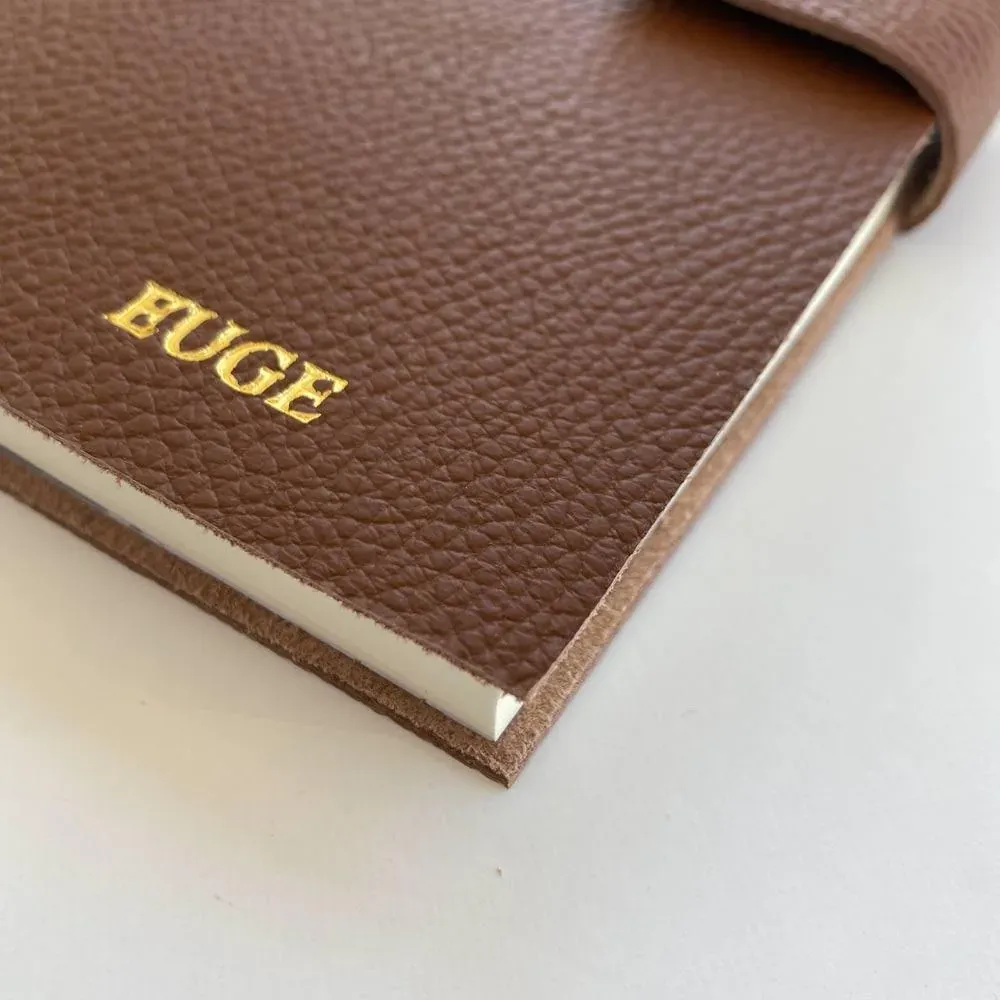
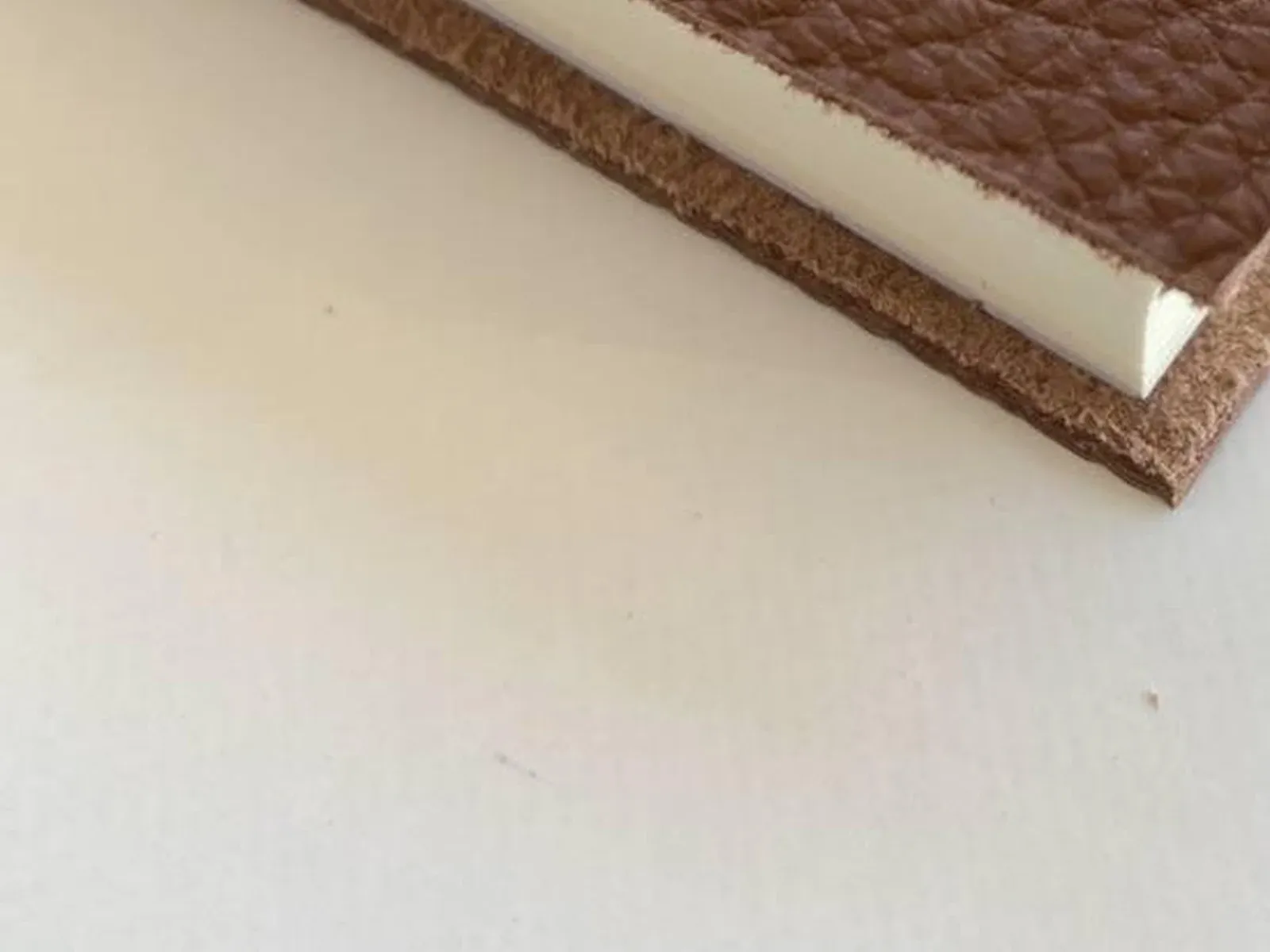
On finished leather, the surface is the tannery's finish system, normally a base coat, a color coat and a top coat over the collagen structure. The adhesive meets that top coat, so the bond is to a polymer film whose chemistry and crosslink density belong to the tannery - not to the fiber structure underneath. This is why two hides that look identical can take the same foil differently. Not every hide works this way: in suede, nubuck or lightly finished leather there may be no continuous film at all, and the foil meets the leather itself. That is a separate case the table does not distinguish, so it has to be trialed as an unknown.
On PU leather, the surface is a polyurethane coating over a woven, knitted or non-woven base, often with its own top coat and often a texture set by a release paper. It is a manufactured film, so it is far more uniform than a hide. That uniformity is one reason a PU program can repeat well once it is set.
On PVC leather, the surface is a PVC compound over a textile base. PVC compounds contain plasticizers, and plasticizer can migrate to the surface over time and under heat. A migrated film can sit between the adhesive and the surface it is meant to bond to - the PVC compound, or a top coat where one is present. PVC also softens more readily than leather under a hot die, so a setting that is comfortable on a hide can put a sink mark or a gloss change into a thin PVC panel.
03 TWO FAILURE MODES THAT LOOK SIMILAR AND ARE NOT
Before asking which material you are on, ask which failure you have, because the two do not share a lever. A mark that is present but follows the weave or the knit is telegraphing. A mark that comes away is a transfer or adhesion failure. Treating the second as the first - lowering pressure to kill a texture that is not there - reduces transfer and can make adhesion worse.
Telegraphing is a pressure, backing and die-hardness question. Die pressure can telegraph the base texture through the coat, and it is not confined to PU: a PVC coat over a textile base can do the same. If the mark lifts, telegraphing is not the diagnosis. Check adhesion first, then look at the layer that failed.
On genuine leather, check whether the failure is at the finish-leather interface or within the finish itself. ISO 11644:2022 measures that interface bond, and the result belongs with the tannery or the finish supplier. If the foil comes away and the finish stays, check whether the adhesive failed at the finish or whether the foil split internally before you change grade.
On PU, the question is which layer failed. If the top coat is still there and the foil has gone, the adhesive did not hold the top coat. If the coat itself has lifted, the coat-to-base bond is the question, not the foil. Lower pressure, better backing or a different die hardness is the lever for telegraphing, not for a lift.
On PVC, first separate uniform from patchy failure. A uniform failure points to the foil's adhesive or to your heat and pressure. A patchy failure, especially after storage or warming, points to something on the surface: plasticizer is the material-specific candidate, but check dust, release agents and hand oils too, and ask whether the PVC carries a top coat, because that mediates the path. PVC also softens more readily than leather under a hot die, so check for sink marks, gloss change or distortion before you change grade.
04 THE MOISTURE PROBLEM, WHICH HITS LEATHER HARDEST
Leather is hygroscopic. It takes up and gives off moisture with the ambient humidity, and moisture held in the substrate can flash to vapor under a heated die and interrupt contact locally. That can produce scattered weak spots rather than a clean lift, which is a pattern worth checking for - though moisture can also show as blisters or haze, so do not rule it out just because the failure looks uniform.
The practical response is to condition the sample to the shop's humidity before stamping, and to stamp it in the same condition it will be in on the line. A hide that has sat in a cold store and is stamped straight away is not the same sample as one that has equilibrated.
Coated fabrics can also carry moisture, especially on a textile base, and some PU systems are moisture-sensitive over time; the difference is that on leather the moisture sits behind the finish, while on a coated fabric the foil meets a polymer coat. Condition both. A common way a leather program goes wrong is to run the trial on whichever material was easiest to obtain and let the production material be the other one.
05 HOW TO RUN THE TRIAL ACROSS THREE MATERIALS
Run the same grade at the same settings on all three, and compare. The point of the exercise is not to find the best setting for each - it is to find out whether they differ at all on your materials, because the application table gives you no way to predict that.
Then check three things on every material, plus a fourth on a hide. Check adhesion with the cross-cut method your customer specifies, ISO 2409:2020 or ASTM D3359-23, and scratch resistance with ISO 1518-1:2023. Check that the mark reads as one field rather than following the base texture. On a hide, check whether the finish lifted - ISO 11644:2022, and only for that case.
For the flex and rub duties that a leather item actually sees, the methods are set out in our PU leather article. They are industry methods for a finished surface, not certificates, and they do not constitute a pass grade for any foil.
06 WHAT TO SEND US
Send a piece of each material from the production lot, each in the finish it will have in production and with the backing or support it will use on the line, not a common finish. For a hide, send a piece from more than one area, because the finish and the grain vary across one skin. For a coated fabric, say whether it is PU or PVC, what the base is - woven, knitted or non-woven - and whether it arrives with a top coat.
Add the die temperature and dwell you normally run, the mark size and finest line width, and the effect you need. If you want a color rather than a metallic effect, say so: our pigment foil is recorded at 90-120 C and names artificial leather among its applications, but not genuine leather, so a hide with a pigment effect is a question for trial.
Standard rolls are 0.64 m x 120 m and 1.28 m x 240 m on a standard carrier; tell us the width and length you need. Bulk use is preceded by a trial on your own materials.
Send all three materials, not the one that is easiest to obtain. Our data gives them one grade and one window, so whether they perform differently only shows up in your own trial.
07 NEXT STEP
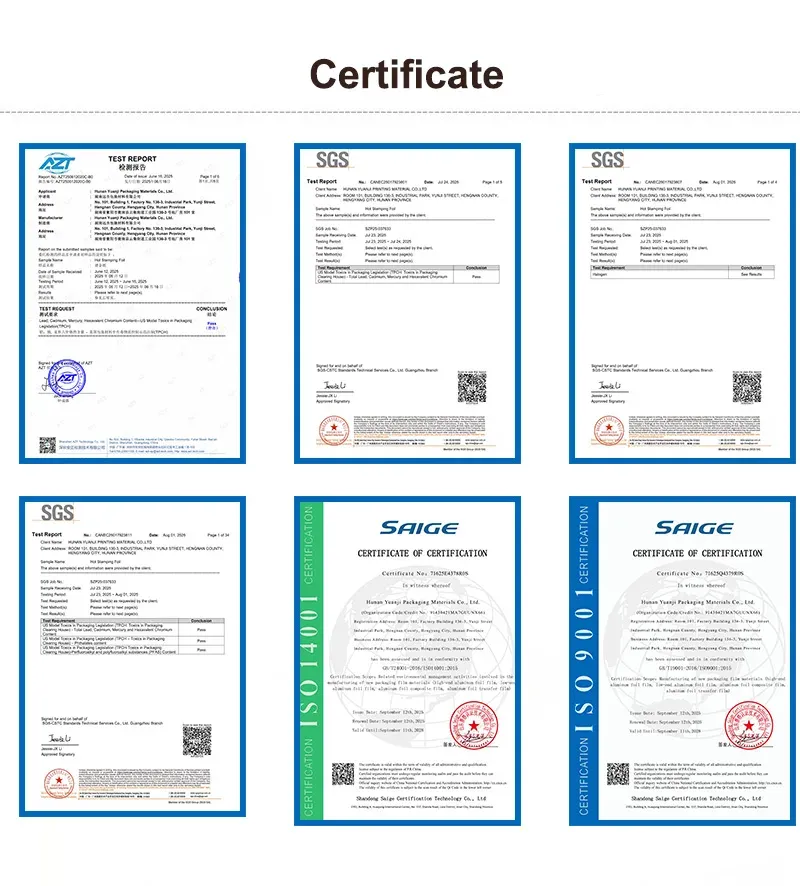
Tell us which materials you stamp and send a swatch of each with its finish. We will send samples of the recorded grade for your trial on each material. Yuanji Foil is a hot stamping and cold stamping foil manufacturer in Hengyang, Hunan, producing standard, coffee-tone, plastic, cold- and hot-stamping, double-sided, pigment, low-halogen and transparent-dielectric foils, including holographic. We hold ISO 9001 and ISO 14001 management-system certificates and import and export rights.