Product Knowledge
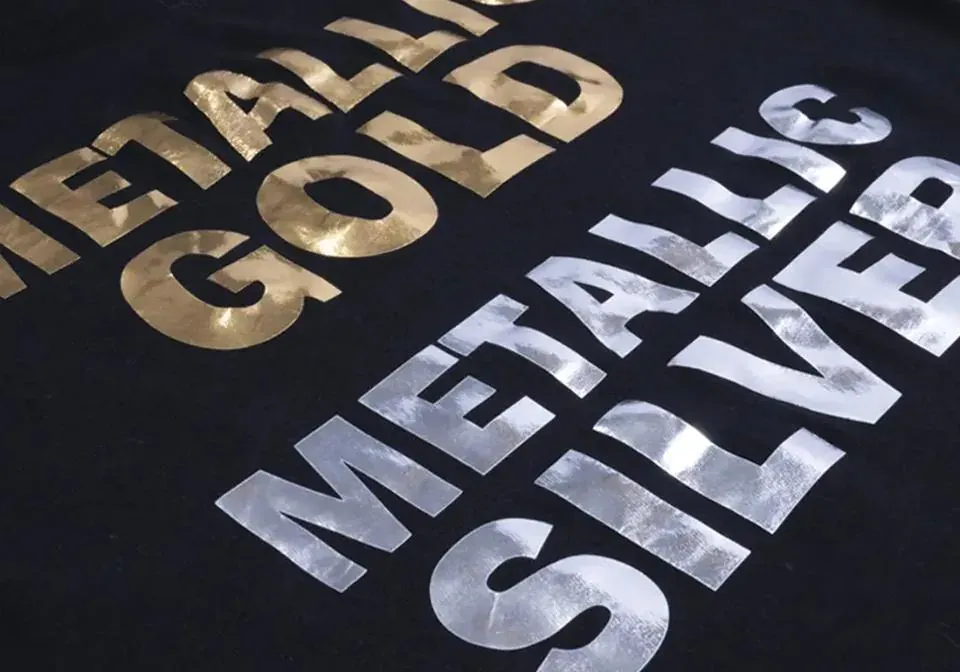
Hot Stamping Foil for Apparel Labels
Labels sit on the paper row and satin on the no-glue row — which records no wash property.

QUICK ANSWER
Before you quote a garment label, check what our application table actually records. The word label does appear in it - on the paper row, where it means a paper label, not a fabric one. Satin is named on the no-glue row, at 90 to 120 C, for satin that arrives with its adhesive layer, and that row records no wash property. Since a garment label is washed with the garment, the wash question is precisely what the record does not answer, and it has to be proven on your own ribbon. On top of that, a label brings three questions no flat panel has: it runs as a narrow strip, it is folded and sewn through, and it often shares its small substrate with printed care information.
The two textile routes and how to test wash resistance are set out in our article Textile Hot Stamping Foil for Polyester Fabric: Which Route Fits. Light fastness and the abrasion trap are in our article Hot Stamping Foil for Home Textiles. This article covers what is specific to a label.
01 THE WORD LABEL IN OUR DATA MEANS PAPER
Start with a distinction that causes real mis-quotes. Our paper row records labels among its applications, at 90-120 C, alongside cartons, greeting cards and printing paper. That is a paper label - a swing tag, a printed paper tag, a paper sticker. It says nothing about a fabric garment label, because a fabric label is not a paper substrate. A woven label is woven from yarn, with woven or cut-and-folded edges; a printed label is printed on a satin, twill or taffeta ribbon. Our table names satin only, on the no-glue row, and does not name twill or taffeta, so those two fall to the general textile row at most and still need a trial.
Now find the fabric. Satin is named in our table, and it is named on the no-glue row: 90-120 C, for flocked cloth and satin that arrive with their adhesive layer, with both roller and flat-bed stamping. That is the row that applies to a satin label supplied with its adhesive layer.
Note what that row does not record: a wash property. No row names a woven label. The general textile row is the nearest route for one, and it is the only row that records a wash property - but it records it for the printed-adhesive process described in our textile article, not for the no-glue route, so it still has to be proven on the label itself. The satin row records no wash property at all.
So the honest position for a garment label is this: the route for satin supplied with its adhesive layer is recorded, and the wash question for that route is not. A supplier who tells you a satin label is wash-resistant because another row records wash resistance on a different process has moved a property between rows.
02 A NARROW STRIP IS NOT A FLAT SHEET
The first thing that changes on a label is the geometry. A label is narrow goods: a strip on a roll or a cut length, fed and stepped through the machine, with a trim allowance at each end and a fold allowance at the end that gets folded.
That means the mark has to sit inside the label face once the side margins and the trim and fold allowances are taken off: the width less the side margins, and the length less the trim and fold allowances. On a roll-fed strip the foil step has to match the label pitch rather than a sheet layout; on cut labels, lay the mark out in the actual cut format. A mark that sits comfortably on a flat sample can fall outside that window, and the fix is layout, not grade.
It also means the sample you send matters. A flat swatch of the same ribbon does not reproduce the feed behavior of the strip, the effect of the roll tension, or how the mark lands relative to the cut. Send a length of the actual ribbon on its roll, or a run of cut labels, not a square cut from the middle.
03 THE FOLD AND THE SEAM
A cut-and-fold label is folded at one or both ends and sewn into a seam. Two things follow, and both are decided at the layout stage.
The fold is a permanent crease, so a mark that crosses it will be folded with the label for the life of the garment. Our data records no fold property, so the answer has to come from a test on the folded label rather than from a grade description. Our article Hot Stamping Foil for PU Leather covers how a stamped layer behaves on a fold; keep the mark off the fold, or accept that the fold is part of the design and test it there.
The seam is where the needle passes. A mark placed inside the seam allowance is perforated by the stitching, so the question is not whether the foil survives the needle but whether you have put the mark where the needle will go. That is a layout decision, and it costs nothing.
Neither point is a grade question, and neither can be answered by a grade description. They are reasons to trial on the assembled label rather than on flat ribbon.
04 SHARING THE SUBSTRATE WITH PRINTED CARE INFORMATION
A garment label usually carries printed information as well as decoration: content, origin, and care symbols. On a small substrate the stamped area and the printed area are close together, often on the same face.
That raises the sequence question in a specific form: is the print applied before the stamp or after it. If the print comes first, the foil meets a printed film rather than the ribbon; if the print comes after, the stamped area has to accept ink. Our post-stamp row addresses the second case for coated art paper, OPP-laminated paper, UV varnish and PVC and ABS surfaces, and it does not name a textile - so for a fabric label that sequence has to be trialed rather than quoted.
There is a practical corollary. If the care information is printed after stamping, the print process sees a surface that is part foil and part ribbon, and the two do not take ink the same way. That is worth raising with whoever prints the label before the order, not after.
05 HOW TO RUN THE TRIAL
Run the trial on the actual ribbon, in the actual format, and check four things.
Does it hold. ISO 2409:2020 for the cross-cut method and ASTM D3359-23 for the tape method. These rate adhesion, not the cause of a failure.
Does it survive the fold. Crease the sample where the finished label will be folded, and look at the crease rather than the flat area.
Does it survive the wash the garment will get. Agree the wash protocol with your customer and run it on stamped labels rather than on the raw ribbon; the comparison and recording method is in the textile article. If color fastness has to be reported as well, ISO 105-C06 covers color fastness to laundering and ISO 105-X12 color fastness to rubbing; both assess the material's color, not the foil's adhesion, and neither is a durability test for the foil.
Is the print still legible. If care information is printed beside or over the mark, check that the print is legible and that the stamped area has not interfered with it.
These are industry methods for a finished surface. They are not certificates and they do not constitute a pass grade for any foil.
06 WHAT TO SEND US
Send a length of the actual label ribbon or a run of cut labels, in the format you will run, and say whether it is woven or printed, and whether it arrives with its adhesive layer.
Tell us the label width, where the fold sits, where the seam allowance is, and the finest line in the mark - so the trial can be laid out inside the usable window rather than on a square sample. If care information is printed on the same label, say whether that print comes before or after the stamp.
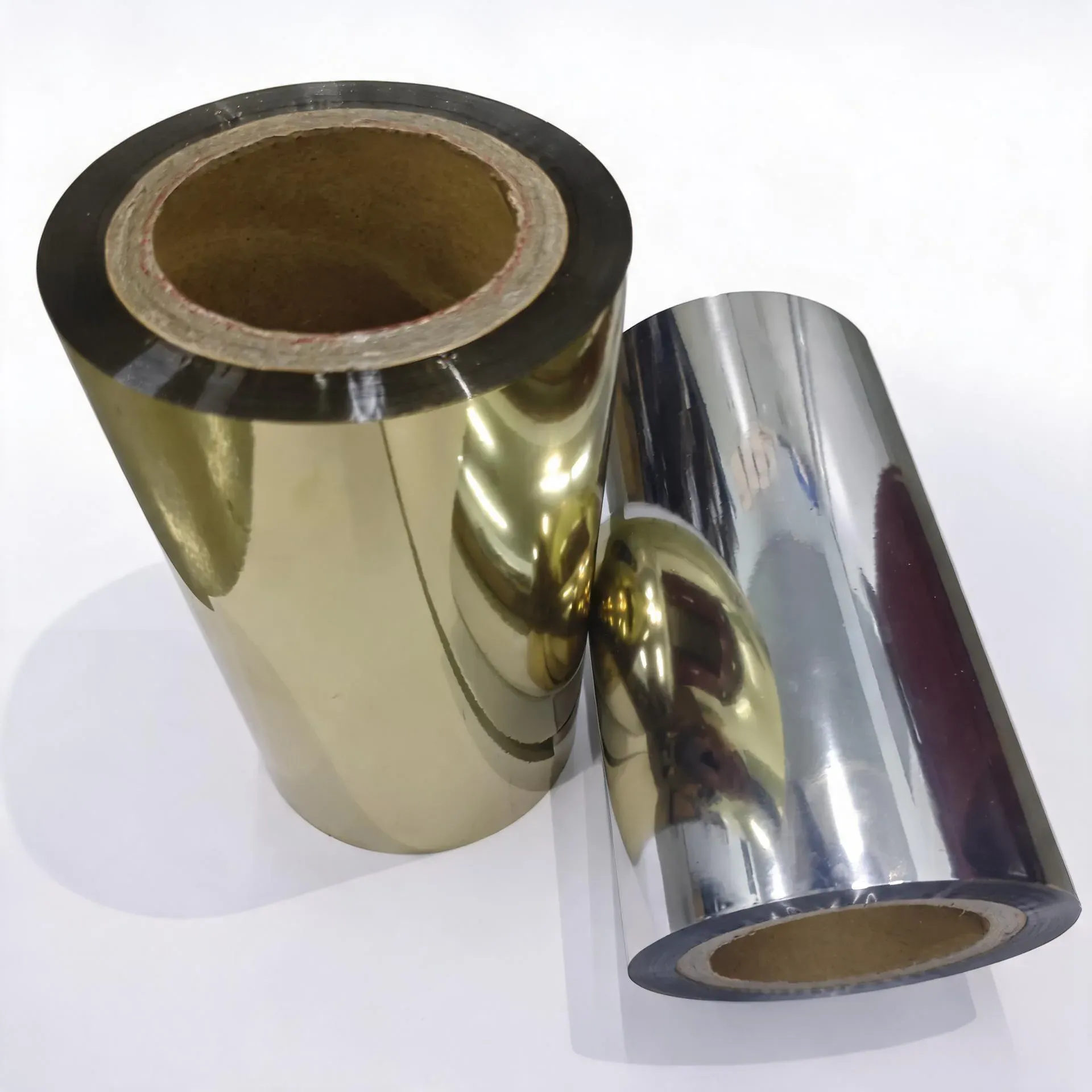
Add your die temperature and dwell, and whether you stamp flat or roller. Standard rolls are 0.64 m by 120 m and 1.28 m by 240 m on a 12 micron carrier, and other lengths are available; tell us what width and length you need. Bulk use is preceded by a trial on your own material.
Send the label in its real format and tell us where it folds and where it is sewn. Our data records the satin route and does not record its wash behavior, so the durability answer has to come from a trial on your ribbon.
07 NEXT STEP
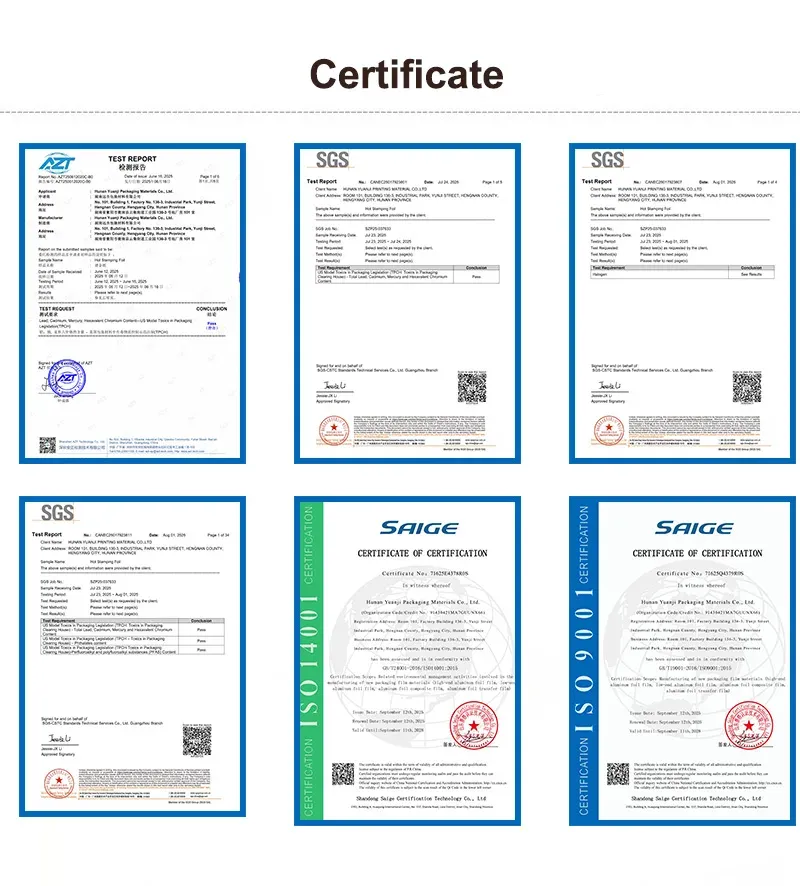
Send a length of the actual ribbon and a description of the finished label. We will match the route and send a sample for your trial. Yuanji Foil is a hot stamping and cold stamping foil manufacturer in Hengyang, Hunan, producing standard, coffee-tone, plastics, cold and hot stamping, double-sided, pigment, low-halogen and transparent-dielectric foils, including holographic. We hold ISO 9001 and ISO 14001 management-system certificates and import and export rights.