Product Knowledge
Hot Stamping Foil for Shoe Uppers
A shoe upper can be leather or textile; our data routes them to different windows and mechanisms.
QUICK ANSWER
A shoe upper is often more than one substrate, and treating it as one is a common mistake. Our data records two different routes under the same finished product: a leather route at 90-120 C with no glue step, and a textile route at 80-145 C where adhesive is printed first, the foil is composited with the fabric, and the carrier is separated afterwards. If one shoe has a leather quarter and a textile tongue, those are two grades and two setups, not one. The second question is where the mark goes: a flat cut part stamped before assembly, and an assembled curved shoe with a lining behind the mark, are different jobs. Get those two answers before you choose a grade.
The bend and rub behavior of stamped leather is covered in detail in our article Hot Stamping Foil for PU Leather, including the flex and rubbing test methods. This article is about the two questions that article does not answer: which substrate family each part belongs to, and when in the build the mark is applied.
01 TWO ROUTES, TWO MECHANISMS
Start with what the foil is actually touching, because in footwear it is rarely one material. A typical upper is a laminate: the face material bonded to a lining, with a toe puff and a heel counter stiffener in many constructions. The face material is leather, coated fabric, or textile, and a single shoe can mix them by panel.
Our leather row is recorded at 90-120 C for PU leather, PVC leather and genuine leather, with good slitting performance. There is no glue step in that row: the heat-activated adhesive on the foil does the bonding directly to the leather surface.
Our textile row is a different mechanism, and it is a common misreading. It is recorded at 80-145 C for cloth and fabric, with the application data describing adhesive printed first, the foil composited with the textile, and the carrier separated afterwards. The same row records good water-wash resistance. That is a printed-glue process, not a direct hot stamp onto fabric. The textile window is wider and the mechanism is different, so a leather setting is not a starting point here - start from the textile window and the printed-adhesive step.
For flocked cloth and satin that arrive with their adhesive layer, our no-glue type is recorded at 90-120 C, with both roller and flat-bed stamping. What it does not record is water-wash resistance, so do not assume the flocked route inherits the textile row's wash behavior.
02 SPLIT THE SHOE BY PANEL, NOT BY PRODUCT
The practical consequence is a panel-by-panel list rather than a single grade. Write down each panel that carries a mark, and for each one name the face material and whether it arrives with its adhesive layer.
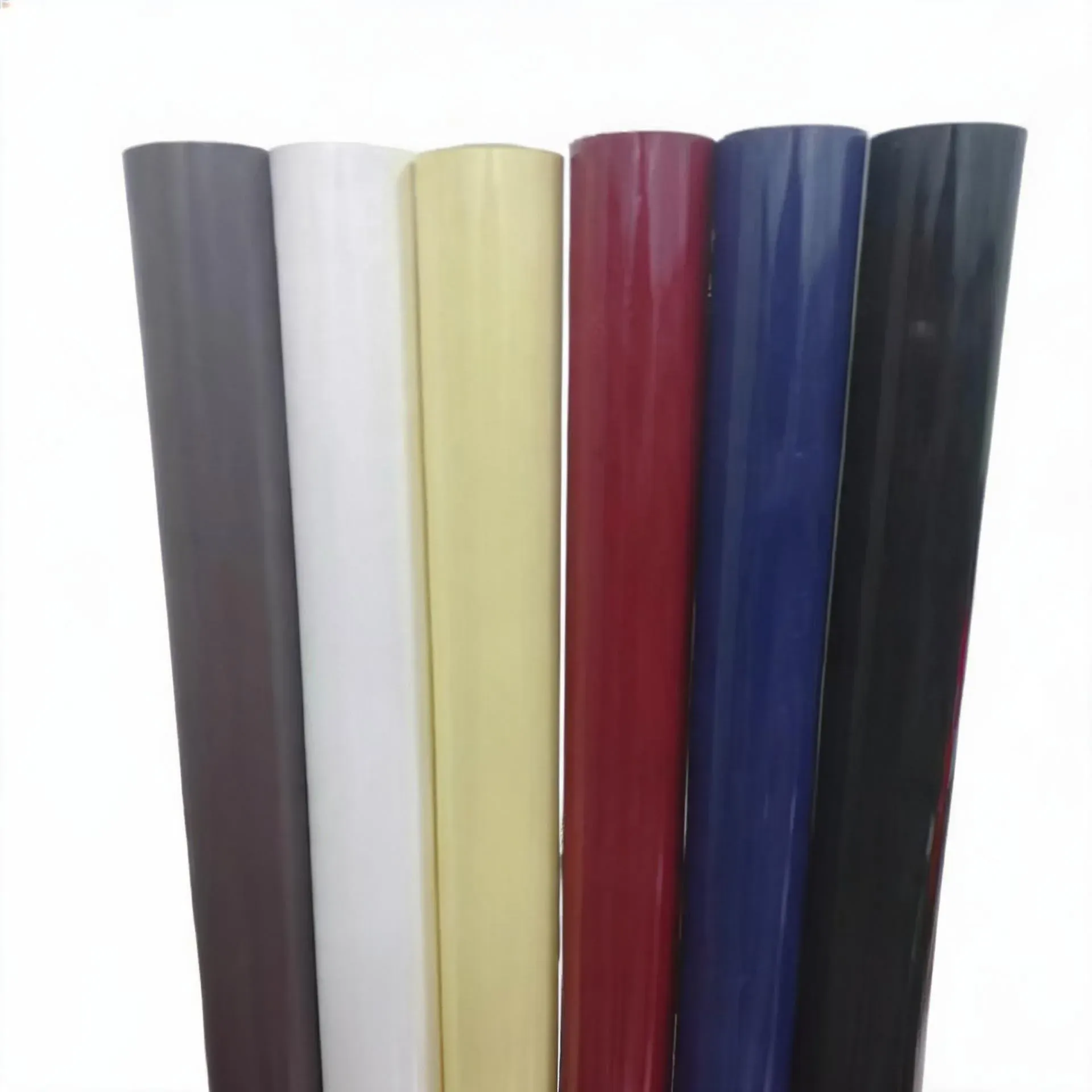
A leather heel counter, quarter panel or toe cap goes to the leather route. A textile tongue or quarter goes to the textile route, with the printed-glue step; mesh is not a recorded substrate, so trial it as an unknown. A flocked or satin trim that arrives with its adhesive layer goes to the no-glue route. An artificial-leather panel - the row's 人造革, whether PU or PVC - that needs a color rather than a metallic effect goes to our pigment foil, which is recorded at 90-120 C and names artificial leather among its applications.
Two consequences often surprise buyers. First, a mixed-material shoe needs more than one trial, because a result on the leather quarter says nothing about the textile tongue. Second, the wash behavior only attaches to the textile route, because that is the only row where our data records it. If a leather panel is expected to survive a wash or a cleaning cycle, that is a question for your own test, not something our data answers.
03 FLAT PART OR ASSEMBLED SHOE
The second decision is when the mark is applied, and it changes the die, the support and the failure mode.
Stamped flat, before assembly, the die meets a flat part rather than a curved shoe, so pressure is easier to keep even and registration follows a printed sheet rather than the shape of the shoe. If the cut part is already laminated to its lining, the die meets a known thickness; if it is stamped before lining, the support behind the mark is different again. This is the route that suits a repeat logo across many cut parts.
Stamped on the assembled shoe, the die meets a curved surface with seams nearby, a stiffener in some areas and none in others, and a cavity behind it that has to be supported or the shell will deform under the die. Registration now follows the shape of the shoe rather than a printed sheet, and any foam or padding behind the mark compresses under pressure - so the same die setting that worked on a flat part is not transferable.
Neither is better. They are different processes, and the grade that suits one is not automatically the grade for the other. If your program does both - a flat logo on a cut part, and a mark on the finished shoe - treat them as two trials.
04 WHERE THE DUTY CONCENTRATES
A shoe does not wear evenly, and the mark should be judged where it sits rather than on average. The vamp is the panel that creases as the shoe flexes in walking, so a mark there sees repeated flexing. The heel and toe see scuffing. The tongue and the area under the lacing see rubbing from the foot and from the lining.
That is why a flex result and an abrasion result are not interchangeable, and why a mark that satisfies one check can fail the other. The leather methods for both, and the distinction between a foil failure and a leather-finish failure, are set out in our article Hot Stamping Foil for PU Leather.
For a textile upper the situation is different, and worth stating plainly: we do not publish a textile-specific abrasion or wash standard for this route. Our data records water-wash resistance for the textile row and nothing more specific. So for flex and abrasion on a textile panel, and for the wash itself, agree the protocol with your customer and test to that.
05 HOW TO RUN THE TRIAL
Run one trial per panel, not one per shoe. For each panel, the sample has to be the actual face material with its actual lining, because the lining changes how pressure is absorbed and how the part recovers.
Two checks run on every panel. Does it hold - ISO 2409:2020 for the cross-cut method and ASTM D3359-23 for the tape method. Does it mark under handling - ISO 1518-1:2023, the constant-loading scratch method.
Then add the checks that belong to that panel's duty. On a leather panel that means the flex and abrasion methods named in our PU leather article. On a textile panel, fix a flex, abrasion and wash protocol with your customer and run that. The wash check applies to the textile route only, because that is the only row where our data records wash resistance.
These are industry methods for assessing a finished surface. They are not certificates and they do not constitute a pass grade for any foil.
06 WHAT TO SEND US
Send a piece of each face material with its lining, cut from the production lot, and say for each one which panel it becomes. Tell us whether the mark goes on a flat cut part or the assembled shoe, and whether the material arrives with its adhesive layer.
Add the die temperature and dwell you normally run, the mark size and finest line width, and the effect you need - metallic or pigment color. Standard rolls are 0.64 m x 120 m and 1.28 m x 240 m on a 12 micron carrier; tell us the width and length you need. Bulk use is preceded by a trial on your own materials.
Tell us the material and the panel for every mark on the shoe, and whether you stamp flat parts or assembled shoes. A single grade is not a safe assumption for a mixed-material upper, and a description alone cannot tell us how each panel will behave.
07 NEXT STEP
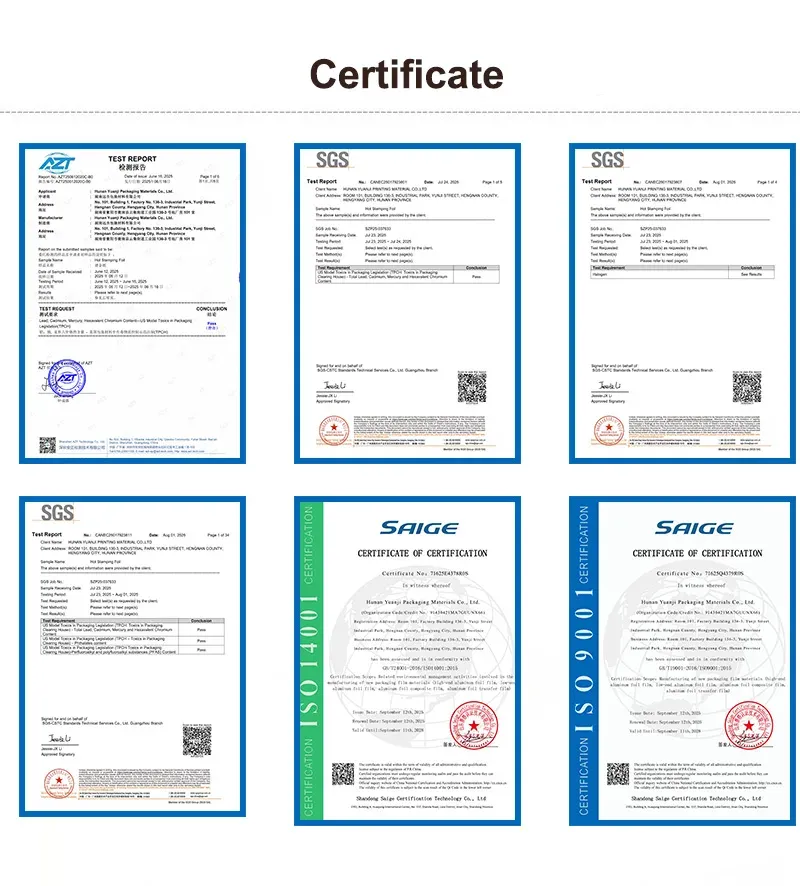
Send a swatch of each face material and tell us which panel it becomes. We will match each one to its recorded grade and send samples for your own trial. Yuanji Foil is a hot stamping and cold stamping foil manufacturer in Hengyang, Hunan, producing standard, cold stamping, holographic, pigment, coffee-tone, low-halogen and transparent-dielectric foils. The ISO 9001 and ISO 14001 certificates we hold are management-system certificates, not product-compliance certificates; we also hold import and export rights.