Product Knowledge
Hot Stamping Foil Peeling: Water-Based Primer
A tape pull shows where the peel failure sits; the reading decides which cause to work on next.
QUICK ANSWER
When foil peels off a water-based primer, the tape pull tells you where the failure sits, and that reading decides which coating-side causes are worth checking. The list runs from the top of the primer down: slip additives and a weak boundary layer on its surface, incomplete film formation, trapped moisture and filler load lowering cohesion inside it, and ink cohesion or ink-to-board anchorage beneath it. The foil side is a separate variable the tape cannot see.
01 FOUR READINGS THAT LOCATE THE FAILURE
Stamp a sample on the production stock, let it cool to room temperature, lay a strip of tape over the image and pull it back steadily, then look at both the foil back and the print with a loupe. The four outcomes below point at different failure locations or patterns, and the reading decides which causes to check.
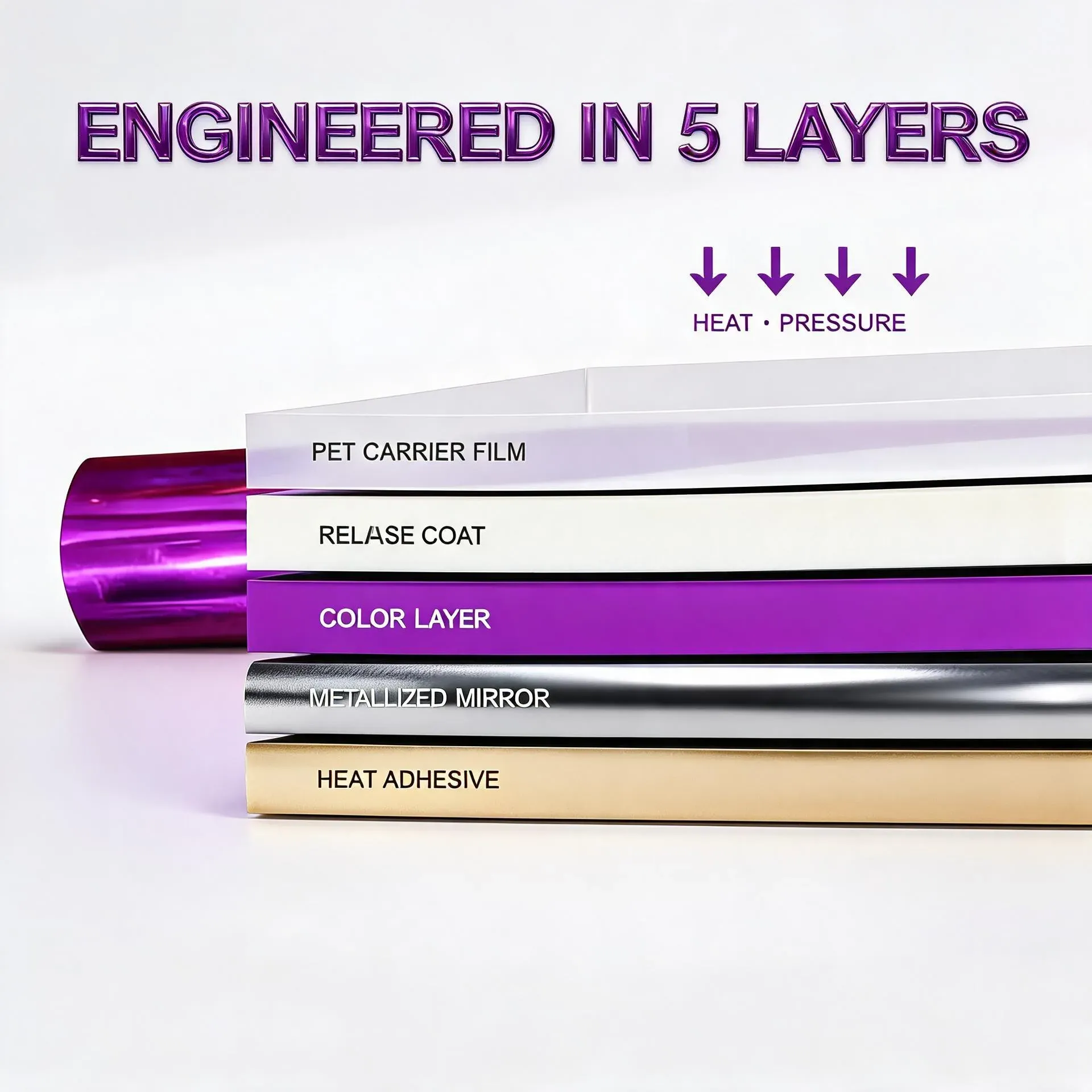
The reading works because stamping foil is a five-layer construction: PET carrier film, release coat, color layer, metallized layer and heat-activated adhesive. On a correct stamp the break happens inside the release interface, so the stack lands intact and every bond underneath stays closed; when foil lifts, something below the release gave way.
A clean foil back and a clean print. The adhesive never bonded, so the failure is at the adhesive-to-primer surface.
White powder on the foil back, or a lighter ghost where the image sat. The primer came apart inside itself, so this is a cohesive failure within the coating rather than at its surface.
Ink traveling with the foil. The primer and the foil both held, so what let go is the ink beneath them: the failure is inside the ink film or at the ink-to-board bond.
An image that looks complete but has scattered pinholes or bare spots. The bonds hold over most of the area and fail locally, so something interfered with contact at those points rather than weakening adhesion overall.
If you need a number instead of a judgment, rate the result with a cross-cut and tape method. ISO 2409:2020 and ASTM D3359-23 are industry references. They define a method, not a pass grade - agree the acceptance level with your customer before the run.
02 FROM READING TO CAUSE
Clean back, clean print. Two coating-side candidates produce this reading, and they fail differently. Where the failure follows the primed area exactly and the same foil holds on uncoated board, the coating surface is the variable. Ask the primer supplier whether the formula carries wax or silicone, and check that candidate first; then use the dyne reading to decide whether to stay there.
Slip additives lower the surface energy. The wax emulsions and silicone flow agents added to stop blocking sit around 20-30 mN/m, against a threshold coating practice quotes around 38 mN/m. As the film dries they migrate to the surface, so the stamping area can carry a release layer. The base acrylic commonly sits at or just under that threshold, so a light slip load can tip a marginal surface further below; a mid-30s reading is where the formula question decides.
A weak boundary layer can leave a surface that still wets but does not hold. Surfactants, dispersants, wetting agents and defoamers also migrate outward as the water leaves, so a very thin low-strength layer can sit on a sound film; the adhesive wets it and fails inside it rather than at a clean interface.
That difference is where the dyne reading helps, as a first discriminator. A value well below the threshold points at a low-energy additive. A reading at or above it removes the low-energy surface as the obvious cause but does not identify a weak boundary layer, because a pen measures surface energy, not cohesive strength; check the foil activation window in section 03 before assuming that layer.
White powder or a ghost. Incomplete coalescence is the first thing to check: a gravure carton or label line dries the coating in-line at high speed, and if drying temperature sits below the emulsion's minimum film-forming temperature, the particles never fuse and the surface stays powdery and porous, the kind of film that lets go. A high filler load such as calcium carbonate lowers cohesion the same way.
Ink traveling with the foil. Because the ink came away, the primer-to-ink bond held and the failure sits below it, inside the ink film or at the ink-to-board bond. Changing the primer surface does not reach a break below the ink; whether the stamping step is implicated is what the unstamped test below decides.
One check confirms it. Run the same cross-cut and tape test on an unstamped area of the same print. If the ink lifts there too, ink anchorage is the variable rather than the stamping step; if it holds, the break is specific to stamping.
Scattered pinholes. Water left inside the film can flash to vapor under a hot die and interrupt contact at those points, so the failure shows up as spots. Workshop humidity is commonly held around 50-60% RH, so a humid season is a reason to check this reading.
03 RULE OUT THE FOIL SIDE
The clean-back reading, and the white-powder reading in its ghost variant, can also come from the foil side through an under-activated adhesive or an over-hot die. An ink-side break is out of reach of a primer-side fix. The die window fits the clean-back reading and the ghost; an unapproved grade fits the clean-back; a batch change can show up in either, because a different adhesive strength changes which layer fails first.
A grade whose recommended die-temperature window sits above what the coating will take. Push the die to activate the adhesive and the primer softens or flows; hold the temperature down and the adhesive under-activates, which reads as poor bonding.
A grade never approved for that coating type. A foil can be good and still be wrong for a water-based film on coated board, because adhesive systems are matched to surface chemistry, not to the material's name.
A batch change. If a working job starts failing with no process change, compare the current batch with the retained sample before rewriting the process.
Two or three grades on the same printed sheet separate foil from coating. If only one grade fails, the grade is the variable. If every grade fails, the surface or the process is the common factor - confirm with the dyne reading and the drying record before blaming the coating.
04 WHAT DATA TO COLLECT
One: the dyne value on the printed area, taken inside the stamping zone. It is the check that follows the additive question on a clean-back reading.
Two: the drying record for that job - dry coat weight, drying temperature and web speed. Primer dry coat weight is commonly suggested at 1.5-3 g/m2, and temperature, speed and coat weight together decide whether the film formed.
Three: the foil grade and batch number, with the die window the supplier recommends for it. If grade and batch are unknown, the foil side cannot be ruled out at all.
Four: first-off and last-off samples from the same run. A single strip from the start is not evidence for the end of it, and drift between them is a reason to check process stability and any mid-run material change.
Alongside those, print a control area with a primer already known to work with your foil, or run the same primer against a second known-good grade. A control that holds points to the original primer or its application as the variable; one that also fails says the whole coating is suspect.
Where you change temperature, pressure or dwell, change one at a time and record each result, because three factors moved together tell you nothing about which one acted. If they interact, run a small set of combinations and record the matrix.
05 WHAT TO ASK YOUR FOIL SUPPLIER
A diagnostic only works if the foil side is specified as tightly as the coating side. Ask for five things in writing: the die-temperature window and approved substrate list; whether the grade tolerates printing or varnishing after stamping; the batch number the sample came from, so your trial matches the bulk you will buy; what the grade was released for; and how the supplier wants a failed sample documented.
Our paper and board grades for packaging are rated 90-120 C on 12 micron PET carrier film, in standard rolls of 0.64 m x 120 m and 1.28 m x 240 m, with other lengths available. Where printing or varnishing follows the stamp, we specify a post-stamp grade for coated art paper, OPP-laminated paper, UV varnish, and PVC and ABS parts in the same window.
Bulk use is preceded by a trial on your own stock, the practical way to see how a specific primer and grade behave together.
A close-up photo of the peeled foil back helps narrow the cause; send one with the sample.
06 NEXT STEP
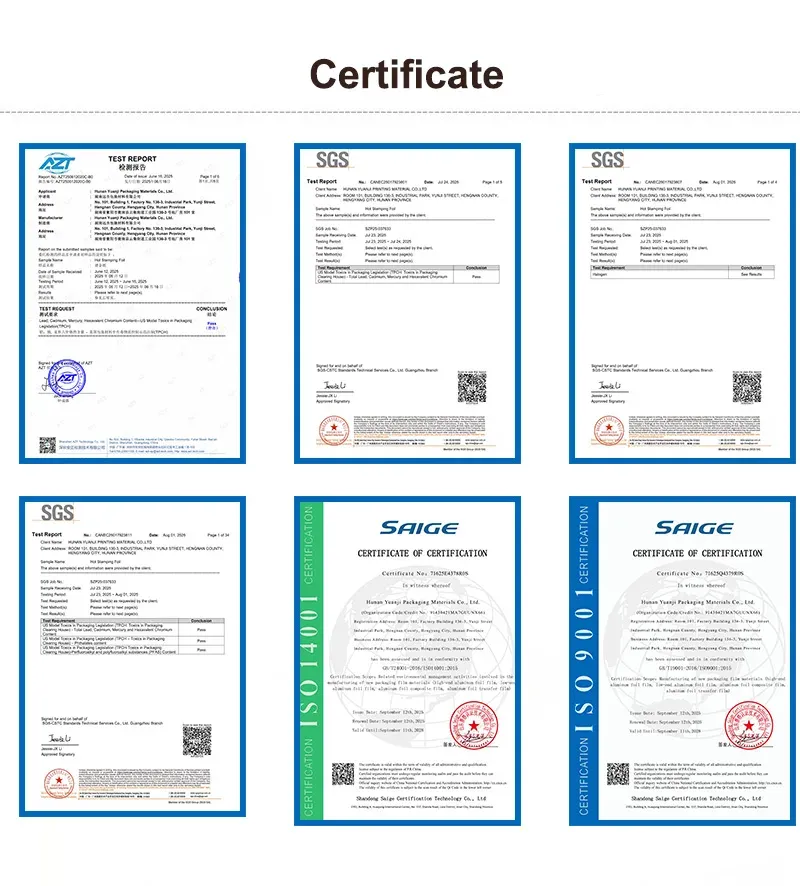
Send the substrate, primer type, dyne reading, dry coat weight, drying temperature and web speed, foil grade and batch, die temperature, pressure and dwell, first-off and last-off samples, and close-up photos of both the foil back and the print side. We will tell you whether a grade in our range is a candidate and prepare a trial sample for your own tape test. Yuanji Foil is a hot stamping foil manufacturer in Hengyang, Hunan: a 20,000 m2 plant with a 1650 mm vacuum coating machine, more than 10 coating machines and 4 holographic embossers, ISO 9001 and ISO 14001 management-system certificates, and import and export rights.