Product Knowledge
Textile Hot Stamping Foil: Which Route Fits
Two textile foil routes compared by temperature and test method — which one suits your fabric?
QUICK ANSWER
Our application data does not name polyester, so no grade can be confirmed from the record alone. What it does define is two routes: an adhesive route at 80-145 C for general textiles, with good water-wash resistance recorded, and an adhesive-free grade at 90-120 C for flocked fabric and silk that already carry adhesive. Which one fits your polyester depends on its construction, its finish and how the article will be washed - so the useful answer is a route plus a test on your own cloth, not a yes or no on the fibre.
01 WHY THE FIBRE NAME ALONE DOES NOT DECIDE IT
It is the question buyers ask, and the easy answer is yes. But polyester is not one surface. A fine woven polyester lining, a coated polyester outer shell, a brushed polyester knit and a polyester-cotton blend behave differently under the same foil, the same temperature and the same adhesive.
Two things change the answer more than the fibre name does. The construction - woven, knit, flocked, or a coating on top - decides how much surface there is for the adhesive to grip and how much heat the cloth will take. The finish - calendered, brushed, water-repellent, or already printed - can prevent the foil from bonding.
That is why our own application data describes textile foil by process and by fabric type rather than by fibre. It records cloth, woven fabric and other textiles for the adhesive route, and flocked fabric and silk for the adhesive-free route. It does not list polyester, and we will not pretend it does.
02 THE TWO ROUTES
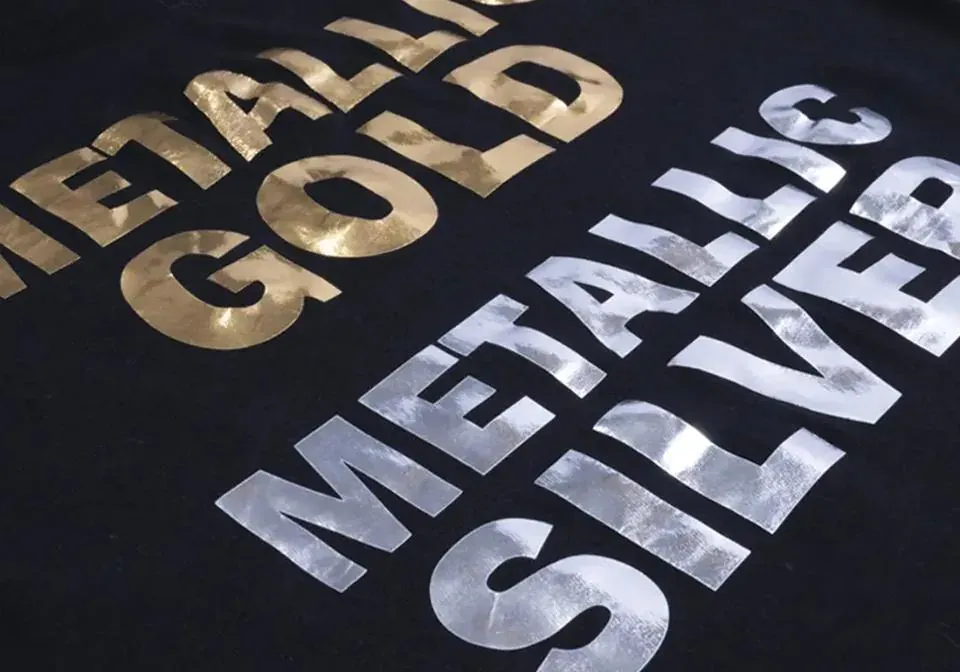
Adhesive route - the general textile route. The adhesive is printed onto the textile first; the foil is then combined with the adhesive-printed textile and the carrier is separated. The reference temperature is 80-145 C. The recorded note is that the adhesive can be printed onto textiles and T-shirts, and the recorded property is good water-wash resistance.
Adhesive-free route. For flocked fabric, silk and similar materials that already carry adhesive, an adhesive-free grade is stamped directly at 90-120 C. The application data lists roller and flat stamping for this route. Here the adhesive is already present on the material, so the foil bonds to what is there rather than to adhesive you printed.
The choice is driven by the process and the substrate, not by the fibre name: one route adds an adhesive printing step, the other only works where the material already provides that layer.
03 FOUR QUESTIONS THAT DRIVE THE ROUTE
Settle these before you commit. The swatch answers the first two; the last two come from how the finished article will be used.
How is the fabric built? A tight woven surface holds an adhesive layer differently from an open knit. Flocked fabric has a raised fibre surface and is recorded under the adhesive-free route because the material already carries adhesive. A coating on the face - polyurethane, acrylic, water-repellent finish - can interfere with adhesive grip.
How much heat will the cloth take? The adhesive route runs 80-145 C and the adhesive-free route 90-120 C. A heat-sensitive fabric usually needs to sit at the low end of that window, and some may not tolerate the adhesive route.
How will the finished article be washed? For the adhesive route, water-wash resistance is a recorded property; the adhesive-free row does not record a wash property, so it has to be proven on your cloth. Wash temperature, detergent and tumble drying all matter, and a sample that survives a cool hand wash may not survive a hot machine wash.
What happens at the edges of the design? Stretch, seams and cut edges are where a metallic effect usually fails first. A design that sits on a flat panel behaves differently from one that crosses a stitched seam or a stretch zone.
04 HOW TO TEST WATER-WASH RESISTANCE
Do not accept a wash claim without a test on your own fabric. Stamp a sample of the actual cloth on the actual route, wash it under the conditions the finished article will really face, dry it the way the customer will dry it, and compare the stamped area before and after.
Record three things at each stage: whether the foil is still fully attached, whether the surface has changed appearance, and whether the edges of the design have lifted. Photograph the sample under the same light before and after, because a change in gloss is easy to miss by eye and obvious side by side.
If your customer specifies colour fastness, the relevant methods sit in the ISO 105 series - laundering and rubbing are the two properties that matter here, in ISO 105-C06 and ISO 105-X12. Agree the part and the acceptance criteria with your customer before the order, not after. These are colour-fastness methods for the finished textile, not an adhesion test and not a foil certification; use them alongside the attachment check above, and always state which part and which acceptance criteria you agreed.
05 WHAT TO SEND FOR A SAMPLE MATCH
Send the actual fabric - not a description of it. Include the construction and the finish, the face side you intend to decorate, the area and position of the design, whether it crosses a seam or a stretch zone, and the wash conditions the finished article must survive.
Add your process if you already know it: whether you can print an adhesive before combining, or whether you need the adhesive-free route because the material already carries adhesive. And say which machine you run - roller or flat - because the application data lists both for the adhesive-free route.
With that we can propose a route and a grade for your trial. Bulk use should always be preceded by a trial on your material; that rule is stated in our product application data.
06 NEXT STEP
Send us a swatch of your fabric and tell us how it will be washed - we will propose the route and a grade for your own test. Yuanji Foil is a hot stamping foil manufacturer in Hengyang, Hunan, producing standard, cold stamping, holographic, pigment, coffee-tone, textile and leather foils.